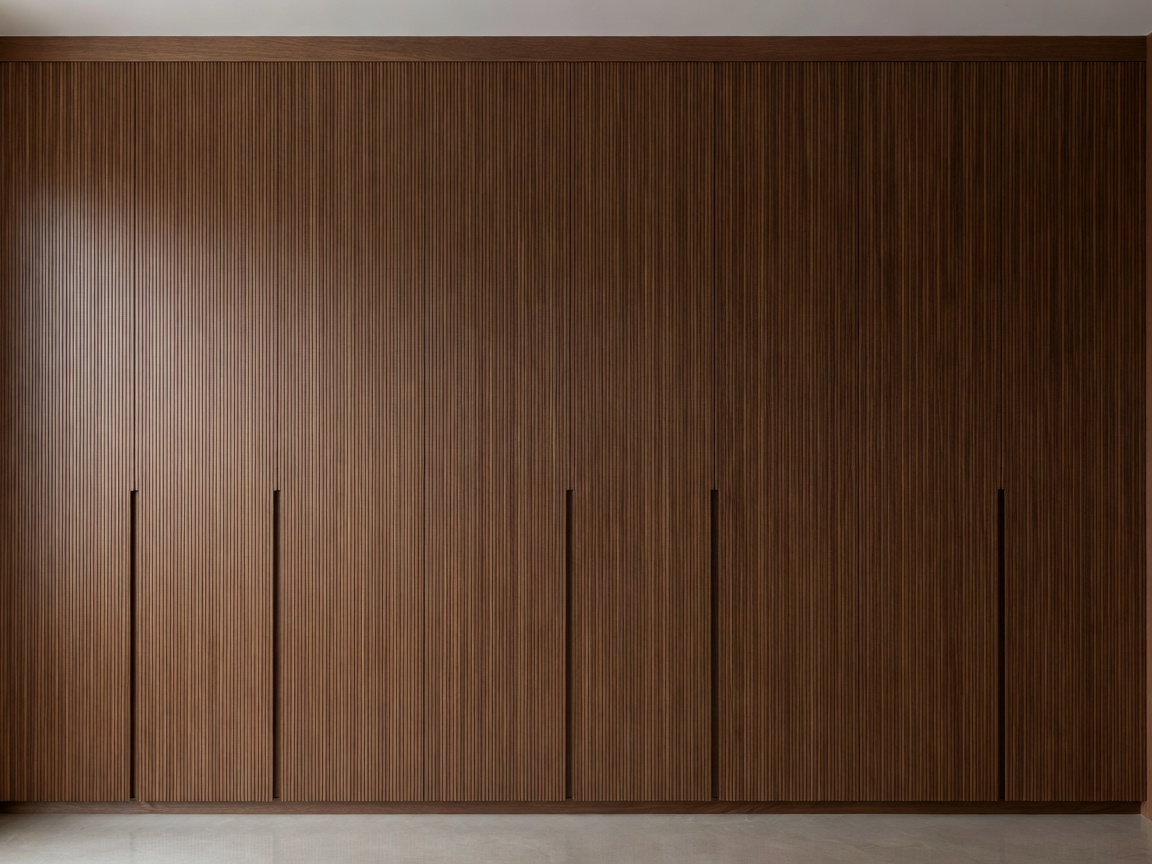
Eliminating the "Box in the Room" Phenomenon
Freestanding wardrobes introduce awkward top crevices where dust gathers and dark shadows pool against the ceiling. In modern restful bedrooms, custom or semi-custom modular joinery should extend fully to the ceiling line, terminated with a crisp 10 mm architectural shadow gap.
When the wardrobe facade meets the ceiling smoothly, it registers as a wall treatment rather than heavy cabinetry. Door panels finished in matte lacquer, natural warm oak veneer, or organic linen wrap introduce tactile richness without competing with the rest of the bedroom elements.
Door Mechanics: Swing, Glide, and Pocket Solutions
Selecting the appropriate door mechanism depends heavily on perimeter clearance and aesthetic intent:
- Hinged Flush Fronts with Push-to-Open: Best for minimal aesthetic uniformity; provides 100% full visual access to the compartment simultaneously. Requires 60 cm swing arc.
- Coplanar Sliding Doors: When closed, doors align in a singular flat plane. When opened, one door glides effortlessly forward and over the adjacent leaf. Ideal for tight footpaths.
- Bifold Pocket Enclosures: Doors swing open and slide neatly back into dedicated side pockets, revealing the entire dressing zone without impeding room traffic.
Internal Cabinet Specifications & Ergonomics
| Storage Section | Standard Depth | Internal Height | Design Recommendations |
|---|---|---|---|
| Full-Length Hanging (Coats, Gowns) | 600 mm – 650 mm | 1500 mm – 1700 mm | Position at ends of wardrobe run; fit with soft-drop hydraulic rail if high |
| Double Short Hanging (Shirts, Trousers) | 600 mm | 1000 mm per tier | Double stack vertically to double everyday garment density |
| Linen & Knitwear Pullout Trays | 500 mm – 550 mm | 180 mm – 220 mm | Solid timber trays with felt inserts prevent wool stretching and snags |
| Accessory & Timepiece Drawers | 450 mm – 500 mm | 100 mm – 120 mm | Incorporate velvet lining and integrated low-glare micro LED strips |
Internal Illumination and Sensor Integration
Fumbling through darkened cabinets disrupts early mornings and circadian stability. Wardrobe interiors should feature vertically routed continuous LED channels (2700K warmth, high CRI 95+) hidden behind a 45-degree aluminum diffuser lip.
Magnetic door contact sensors provide immediate soft illumination upon opening, casting gentle, shadow-free light onto fabrics without spilling blinding lumens into the wider bedroom space.