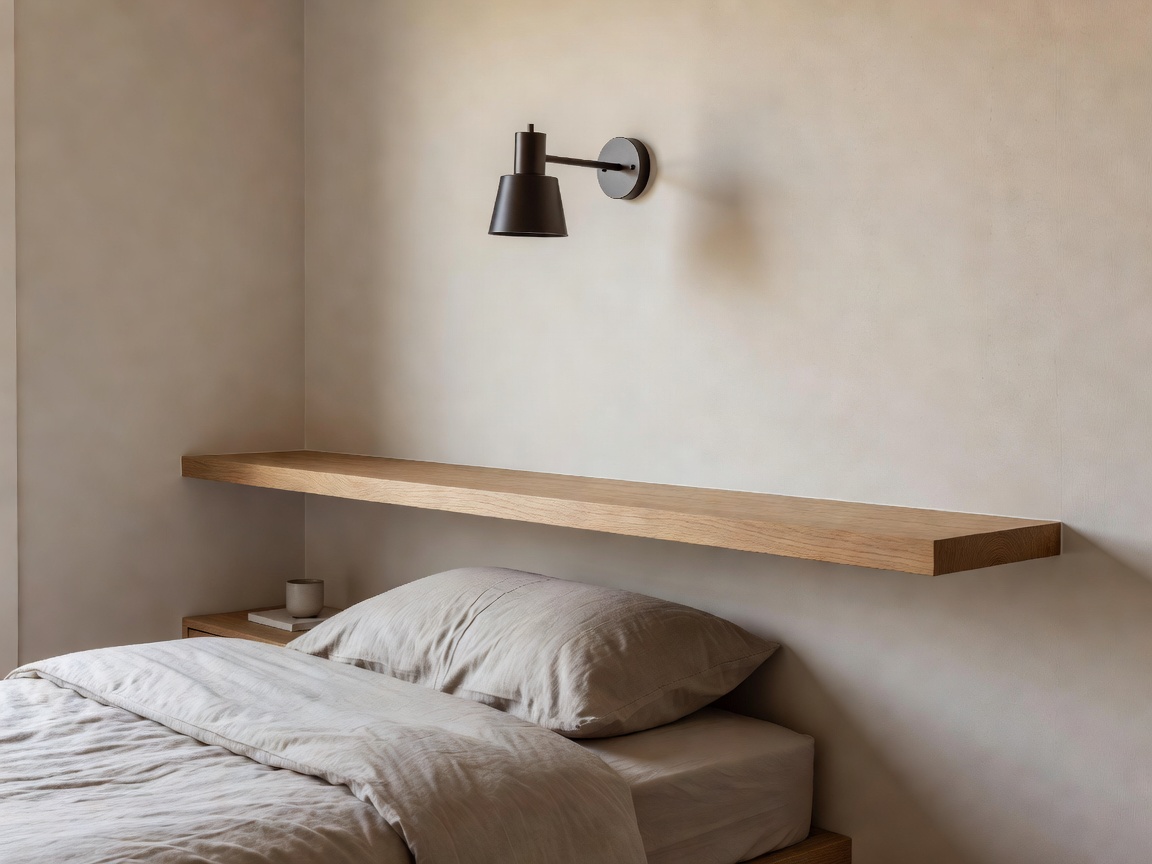
The Power of Unbroken Floor Planes
The human eye calculates the volume of a room by tracking the continuous perimeter of visible floorboards. As soon as traditional legged furniture clutters the floor boundary, a room feels fractured and congested.
To counteract this, architectural designers employ wall-mounted cantilevered nightstands that sit 45 cm above the floor. Suspending bedside ledges creates uninterrupted line-of-sight across the skirting boards, tricking the brain into perceiving a generous, cohesive room boundary.
Strategic Color Drenching vs. High Contrast
Conventional advice once recommended painting small rooms sterile stark white. However, harsh bright whites expose sharp corner intersections, drawing attention to boundaries and tight angles.
A more sophisticated approach is tone-on-tone color drenching using soft organic shades: warm beige, soft cocoa, and chalky dusty rose. When walls, baseboards, door architraves, and ceiling cornices share an identical low-reflectance mineral hue (such as a 3% sheen chalk emulsion), perimeter boundaries dissolve. The eye glides across surfaces without encountering jarring edges, generating a serene coccoon effect.
Bed Placement & Storage Trade-offs
| Layout Configuration | Pros | Cons | Recommended Room Dimensions |
|---|---|---|---|
| Corner-Tucked Platform | Frees open 60% of central floor; creates nested nook | Only one open side for entering bed; sheet changing requires reach | 2.6 m × 2.8 m (under 8 m²) |
| Centred Bed with Built-in Wardrobe Surround | Symmetrical balance, hotel-like intimacy, maximum vertical storage | High custom joinery investment; reduces open wall space | 3.0 m × 3.2 m (approx 10 m²) |
| Under-Bed Hydraulic Lift Joinery | Gains over 700 litres of concealed seasonal linen capacity | Slightly heavier frame; requires clearance at foot of bed | 2.8 m × 3.5 m (approx 10 m²) |
Eliminating Visual Micro-Distractions
In a small bedroom, small objects produce disproportionate visual volume. A tangle of device charging cables on a nightstand has the psychological weight of a pile of books.
Implement drawer-internal electrical outlets, recessed directional reading spots (30-degree beam angle to prevent light spill across the bed), and floor-to-ceiling sheer linen curtains hung on flush ceiling tracks. By running window curtains from wall to wall rather than framing just the glass aperture, the window wall reads as a singular architectural drapery plane rather than an awkward gap.